Journey to Space: Far Out
In Fall of 2024, the North Carolina Museum of Natural Sciences welcomed the traveling exhibit Journey to Space. This exhibit highlights the challenges that astronauts face onboard the International Space Station, and showcases the cutting-edge technologies that have been developed for human space travel and astronomy research.
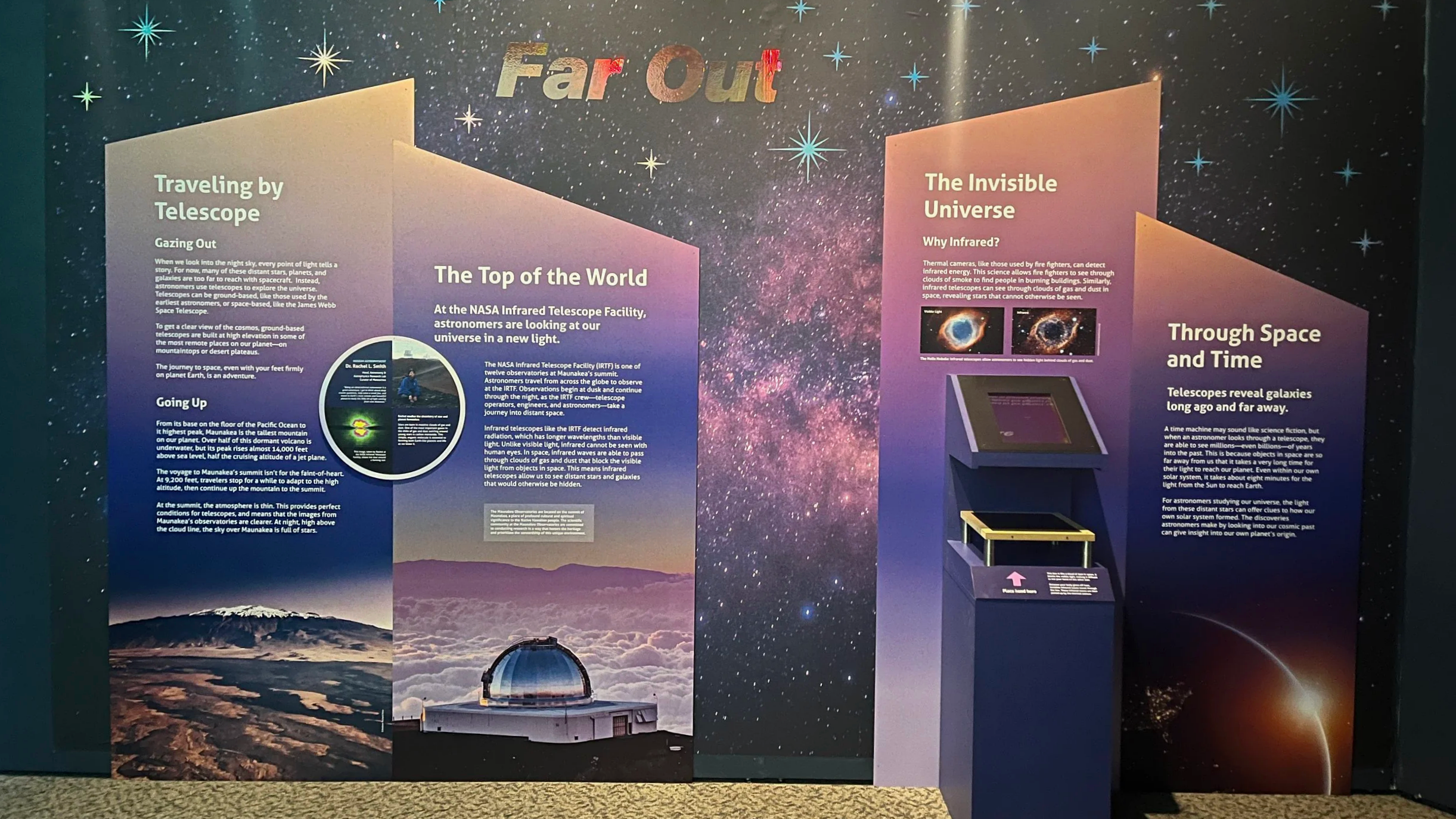
For this NCMNS Research Highlight, we featured the Museum’s Head of the Astronomy & Astrophysics Research Lab, Dr. Rachel Smith, and introduced visitors to the science behind NASA’s IRTF, the infrared telescope that Rachel uses to study stars in distant space. This exhibit addition, titled Far Out, featured a thermal camera interactive that demonstrated to the visitor how telescopes are able to “see” infrared waves, even through obstacles visible electromagnetic waves cannot pass through.
—
Traveling by Telescope
Gazing Out
When we look into the night sky, every point of light tells a story. For now, many of these distant stars, planets, and galaxies are too far to reach with spacecraft. Instead, astronomers use telescopes to explore the universe. Telescopes can be ground-based, like those used by the earliest astronomers, or space-based, like the James Webb Space Telescope.
To get a clear view of the cosmos, ground-based telescopes are built at high elevation in some of the most remote places on our planet—on mountaintops or desert plateaus. The journey to space, even with your feet firmly on planet Earth, is an adventure.
Going Up
From its base on the floor of the Pacific Ocean to its highest peak, Maunakea is the tallest mountain on our planet. Over half of this dormant volcano is underwater, but its peak rises almost 14,000 feet above sea level, to half the cruising altitude of a jet plane.
The voyage to Maunakea’s summit isn’t for the faint-of-heart. At 9,200 feet, travelers stop for a while to adapt to the high altitude, then continue up the mountain to the summit.
At the summit, the atmosphere is thin. This provides perfect conditions for telescopes, and means that the images from Maunakea’s observatories are clearer. At night, high above the cloud line, the sky over Maunakea is full of stars.
-
The Top of the World
At the NASA Infrared Telescope Facility, astronomers are looking at our universe in a new light.
The NASA Infrared Telescope Facility (IRTF) is one of twelve observatories at Maunakea’s summit. Astronomers travel from across the globe to observe at the IRTF. Observations begin at dusk and continue through the night, as the IRTF crew—telescope operators, engineers, and astronomers—take a journey into distant space.
Infrared telescopes like the IRTF detect infrared radiation, which has longer wavelengths than visible light. Unlike visible light, infrared cannot be seen with human eyes. In space, infrared waves are able to pass through clouds of gas and dust that block the visible light from objects in space. This means that infrared telescopes allow us to see distant stars and galaxies that would otherwise be hidden.
—
The Invisible Universe
Why Infrared?
Thermal cameras, like those used by fire fighters, can detect infrared energy. The science that allows fire fighters to “see” through clouds of smoke and find people in burning buildings also allows infrared telescopes to see through clouds of gas and dust in space, revealing stars that cannot otherwise be seen.
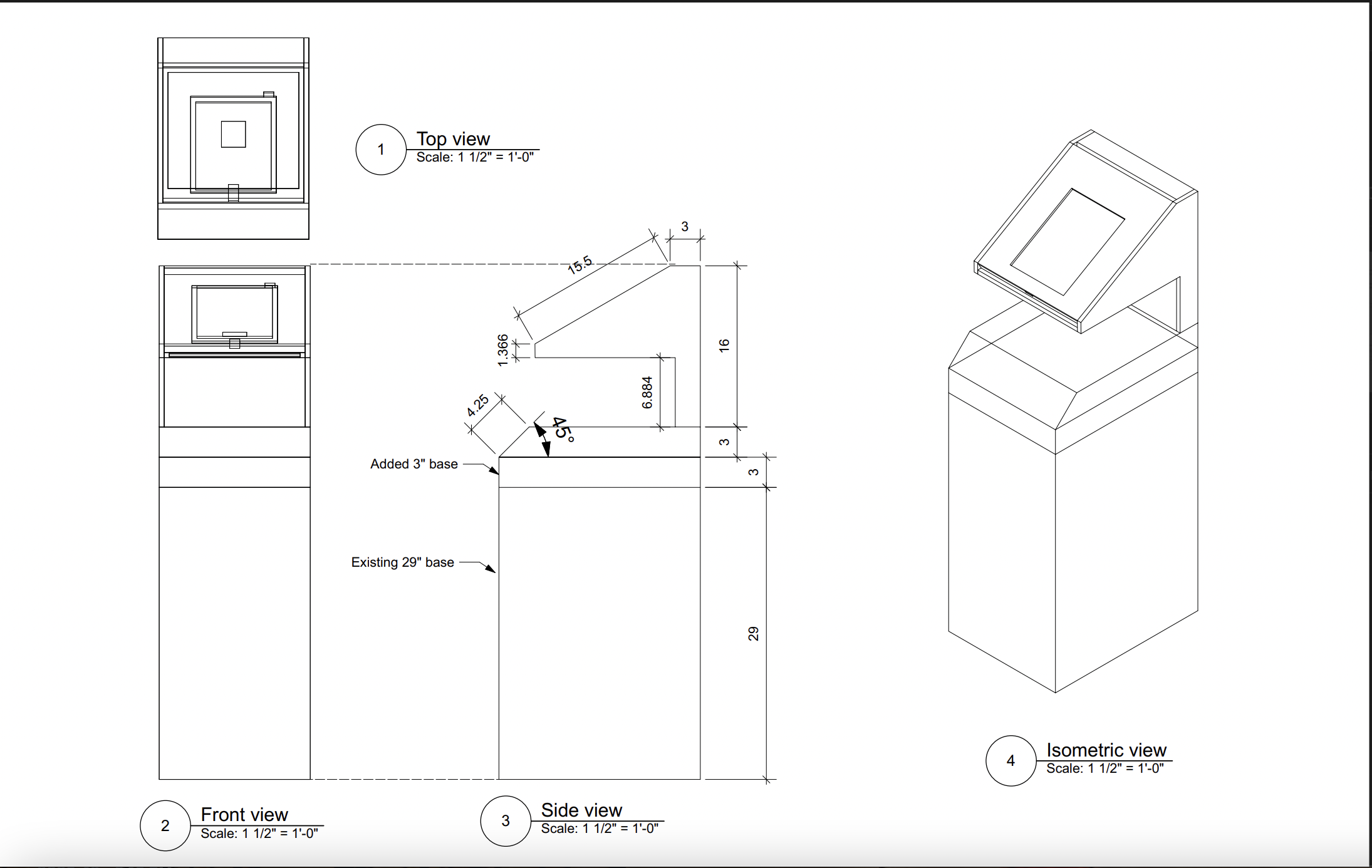
Camera Interactive Instructions: Place hand here
This box is like a cloud of dust in space. It blocks the visible light, making it difficult to see your hand on the other side.
Because your body gives off heat, invisible infrared waves travel through the box. Those infrared waves are then picked up by the thermal camera on the other side. Like a hidden star, your hand becomes visible through the power of infrared imaging.
—-
Through Space and Time
Telescopes reveal galaxies long ago and far away.
A time machine may sound like science fiction, but when an astronomer looks through a telescope, they are able to see millions—even billions—of years into the past. This is because objects in space are so far away from us that it takes a very long time for their light to reach our planet. Even within our own solar system, it takes about eight minutes for the light from the Sun to reach Earth.
For astronomers studying our universe, the light from these distant stars can offer clues to how our own solar system formed. The discoveries astronomers make by looking into our cosmic past can give insight into our own planet’s origin.
